

Introduction
When most people hear the phrase “a Section 42 asset-for-share transaction”, the immediate response is usually a mix of confusion, mild panic, and the strong temptation to pretend they never asked! It sounds technical, intimidating and overly complex.
However, Section 42 is often far more practical than its infamous reputation suggests. In practice, it serves as a valuable financial mechanism within the South African tax framework, frequently relied upon in commercial restructurings.
When applied correctly, it can facilitate the efficient reorganisation of assets and business operations without creating unnecessary tax friction, thereby supporting continuity and long-term planning rather than imposing immediate monetary consequences for individuals or companies relying on this provision.
So, while it may sound like a tax nightmare, Section 42 is often a useful and legitimate tool when structuring businesses or planning ahead within the wider business world.
The Meaning of a Section 42 Asset-for-Share Transaction.
In short, Section 42 applies when a person transfers an asset to a company in exchange for equity shares, allowing the transaction to take place on a rollover basis so that the usual tax disposal consequences, including capital gains tax, are deferred rather than triggered immediately.
In layman’s terms, an individual disposes of an asset (such as land, a farm, or business property) and, in return, the company issues equity shares to that individual, with the result that the individual holds at least 10% of the equity shares and voting rights in that company immediately after the transaction.
Consequently, subject to a few other requirements, the transaction then qualifies for roll-over relief, meaning the normal capital gains tax consequences are deferred rather than triggered immediately.
The underlying logic of this mechanism is that the person has not truly “cashed out” of the asset, they have simply converted their ownership from holding the asset directly to holding shares in the company that now owns it.
However, the key principle to remember is that, for tax purposes, the asset is treated as being transferred at its original base cost rather than at its current market value. The transferee company effectively steps into the shoes of the transferor by acquiring the asset at the same base cost, and the shares received by the transferor inherit that rolled-over base cost.
This means that any built-up gain in the asset is not eliminated but merely deferred and carried over into the shares issued as consideration. The deferred gain will only be realised and taxed in the future when the shares or the underlying asset are ultimately disposed of in a fully taxable transaction.
In this way, Section 42 serves as an important restructuring tool, allowing assets to be moved into corporate vehicles without an immediate tax burden, while ensuring that the tax liability is preserved for a later disposal.
A Practical Example: Transferring an Asset Into a Company.
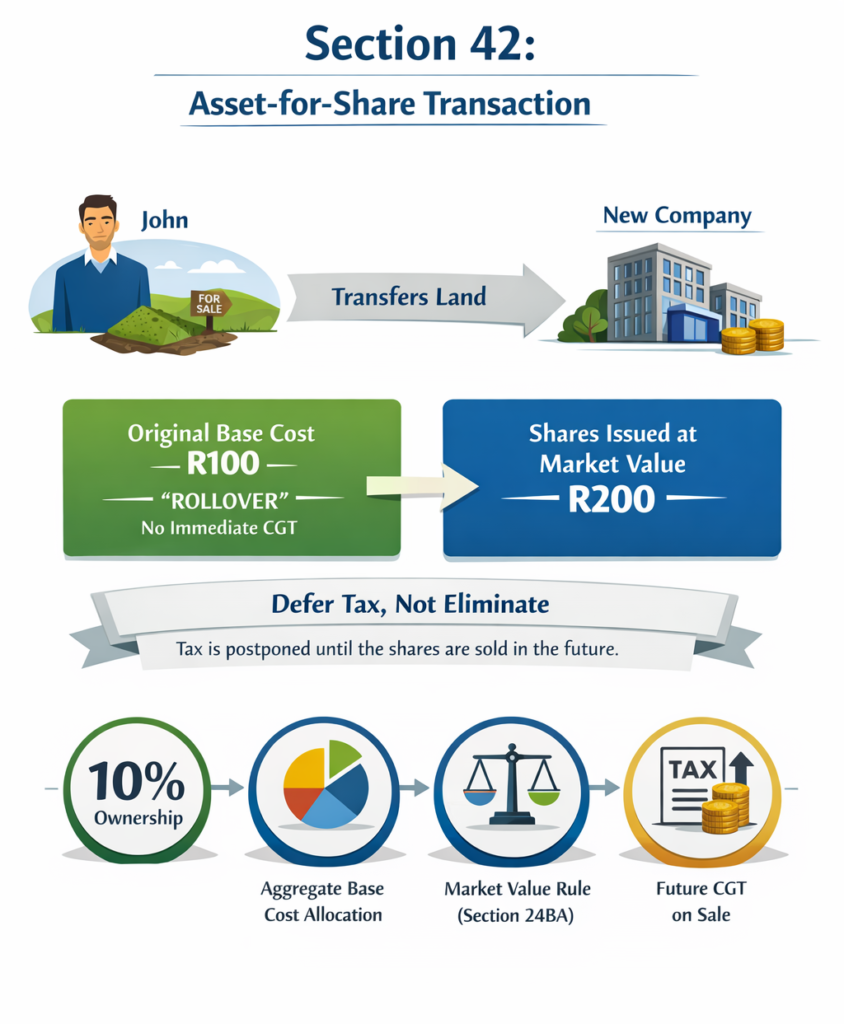
Let’s consider the following basic scenario: John owns vacant land purchased years ago for R100, which is now worth R200. He wants to transfer the land into a newly formed company in exchange for shares in that company.
If Section 42 applies, John is treated as disposing of the land at its original base cost (R100), so no immediate capital gain arises. The company is likewise treated as acquiring the land at the same base cost. John receives shares in the company as consideration, and the base cost of those shares is effectively rolled over from the land transferred to the company.
Nevertheless, it is important to remember that John’s shares effectively inherit the tax history of the land. This means the built-in gain of R100 is not eliminated but merely deferred. If John later sells the shares for their market value of R200, the deferred capital gain of a R100 will then be realised, and SARS will come to collect its share, as it likes to do.
The Problem of Multiple Assets and Base Cost Distortion.
It is, furthermore, also important to note that complications can arise where multiple assets are transferred in exchange for only a small number of shares.
For example, Asset A may be worth R200 000 and Asset B worth R800 000, yet the company issues only two shares in return. If one share is informally linked to each asset, the base cost allocation can become distorted. This may produce artificial gains or losses when the shares are later sold, because the shares do not properly reflect the true value of what was transferred.
Put simply, the shares issued in exchange for the asset are not intended to represent individual assets on a one-for-one basis. Instead, the shares are treated as consideration for the total package of assets transferred.
The aggregate base cost of the assets disposed of is therefore rolled over into the shares received, and that base cost must be allocated across the shares on a reasonable and supportable basis for future tax purposes.
Accordingly, while the number of shares issued is a commercial decision, proper record-keeping and careful base cost allocation are essential to avoid unintended tax outcomes when the shares are ultimately disposed of.
The Value-for-Value Rule: Section 24BA.
It is further important to keep in mind that even where a transaction qualifies for rollover relief under Section 42, it is important to be mindful of the anti-avoidance provisions contained in Section 24BA of the Income Tax Act.
Section 24BA is aimed at preventing value-shifting arrangements where assets are transferred to a company in exchange for shares, but the consideration does not properly reflect the market value of what is being transferred.
In certain circumstances, SARS may treat a mismatch between the value of the asset transferred and the value of the shares issued as giving rise to unintended tax consequences.
The application of Section 24BA is highly fact-specific and depends on the structure of the transaction, the relationship between the parties, and whether the arrangement results in a benefit or value shift within the company.
Importantly, there are circumstances in which Section 24BA does not apply, including certain intra-group restructurings and transactions that fall within specific exclusions contained in the legislation.
For this reason, proper structuring and professional advice are essential to ensure that a Section 42 transaction achieves its intended tax-deferred outcome without triggering additional tax consequences under Section 24BA
Key Takeaways.
- Section 42 is a powerful corporate restructuring tool, but it must be applied correctly.
- It postpones capital gains tax rather than eliminating it entirely.
- The transferor must acquire and hold at least 10% of the equity shares and voting rights in the transferee company.
- The number of shares issued is flexible, but the structure must be carefully considered to avoid base cost distortions.
- Transfers involving multiple assets, or assets acquired before the valuation date, can create significant record-keeping and base cost allocation challenges.
- Section 24BA’s value-for-value rule must always be taken into account to ensure the shares issued match the market value of the asset transferred.
Conclusion.
Section 42 asset-for-share transactions can provide significant tax relief and valuable structuring opportunities for individuals and businesses looking to transfer assets into corporate vehicles.
While the provision may sound intimidating, it is ultimately a practical mechanism designed to facilitate legitimate business planning, estate structuring, and group reorganisations without triggering immediate tax costs.
At De Beer Attorneys, we regularly assist clients with corporate restructurings and asset transfers, guiding them through the technical requirements to ensure the transaction achieves its intended outcome.
If you are considering transferring assets into a company or restructuring your business, contact us today.