
Introduction.
Contracts form the foundation of nearly every aspect of modern life, from renting a home and purchasing products to starting a new job or accepting online terms and conditions. Though often overlooked, these everyday agreements carry real legal weight and can have lasting consequences if misunderstood.
At De Beer Attorneys, we believe that understanding the principles of contract law is not just a legal necessity but a practical skill that empowers individuals and businesses alike to protect their interests, avoid costly disputes, and make informed decisions with confidence.
What Is a Legally Enforceable Contract?
Before exploring the details and nuances of specific contracts, it is important to first understand what a contract entails. The term ‘contract’ serves as an umbrella concept, encompassing most, if not all, legally binding agreements. In essence, a contract can be defined as follows:
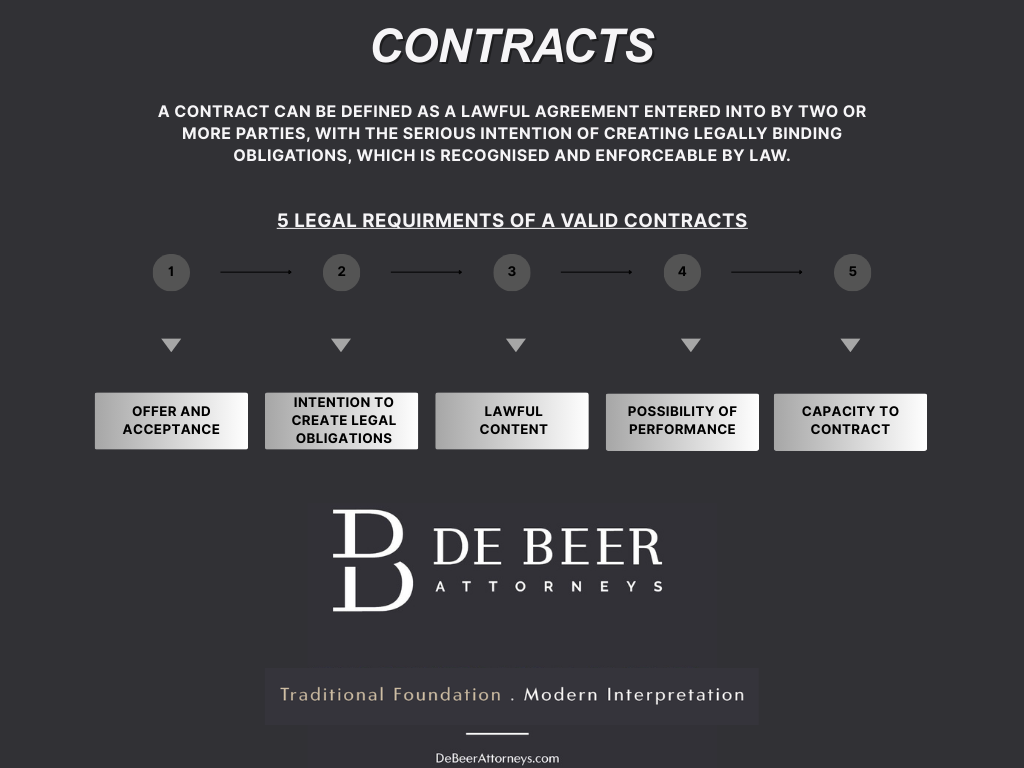
- A lawful agreement entered into by two or more parties, with the serious intention of creating legally binding obligations, which is recognised and enforceable by law.
Furthermore, contrary to common belief, a contract does not always need to be reduced to writing in order to be valid and enforceable. South African law recognises both written and oral contracts, provided that the essential elements of a valid agreement are present.
However, in practice, written contracts are strongly preferred. They offer certainty by clearly recording the agreed terms, minimising the risk of misunderstandings and providing reliable documentary proof in the event of a dispute.
Key Requirements for a Valid Contract.
For a contract to be legally enforceable, several elements must be present:
- Offer and acceptance: There must be a clear offer by one party and an unambiguous acceptance by the other. Without mutual agreement, there is no contract.
- Intention to create legal obligations: The parties must intend for their agreement to have legal consequences. Agreements made jokingly or in a purely social context without a true intention to contract between the parties will not qualify.
- Lawful content: The purpose of the contract must be legal and not against public policy. Contracts involving illegal activity are automatically void.
- Possibility of performance: The terms must be capable of being performed. If the obligations are impossible to carry out from the start, the contract cannot be enforced.
- Capacity to contract: All parties must have the legal capacity to enter into the agreement. For example, minors or persons declared mentally unfit may lack capacity and will need a curator to act on their behalf.
If any of these elements are missing, the agreement may not be enforceable in law, subject to certain exceptions.
What Happens When a Contract Is Breached?
A breach of contract occurs when one party fails to perform their obligations within the confines of the contract without a valid legal justification. This could be something as simple as missing a payment deadline or as serious as walking away from a business deal entirely.
The remedies available depend on the nature and seriousness of the breach. These may include:
- Cancellation of the contract.
- Claiming damages for any financial losses.
- Demanding specific performance, such as delivery of goods or completion of work.
- Mediation/Arbitration.
Importantly, contracts should contain specific clauses that deal with what happens in the event of a breach, including notice periods, penalties, and dispute resolution mechanisms.
Common Contract Types.
The most common types of contracts encountered in both the business world and everyday life include the following:
- Commercial contracts such as service agreements, shareholder agreements, and supply contracts.
- Property agreements including lease agreements, sale agreements, and building contracts.
- Employment contracts and related workplace documentation.
- Family law contracts such as antenuptial contracts.
- Litigation-related contracts, including settlement agreements and acknowledgements of debt.
Each type of contract carries its own legal nuances and risks and should be approached with specialised care.
Conclusion.
Contracts are far more than mere legal formalities, they serve as essential tools for protecting your rights, managing risk, and creating certainty in both personal and professional relationships. A well drafted contract provides clarity on each party’s obligations, sets expectations, and reduces the likelihood of misunderstandings or disputes.
If you are entering into a contract, or require assistance with reviewing, negotiating, or drafting one, our team at De Beer Attorneys is here to help. We offer trusted, practical legal guidance at every stage, from the initial consultation through to final signature. We are here to ensure that your agreements are robust, enforceable, and tailored to meet your specific needs.